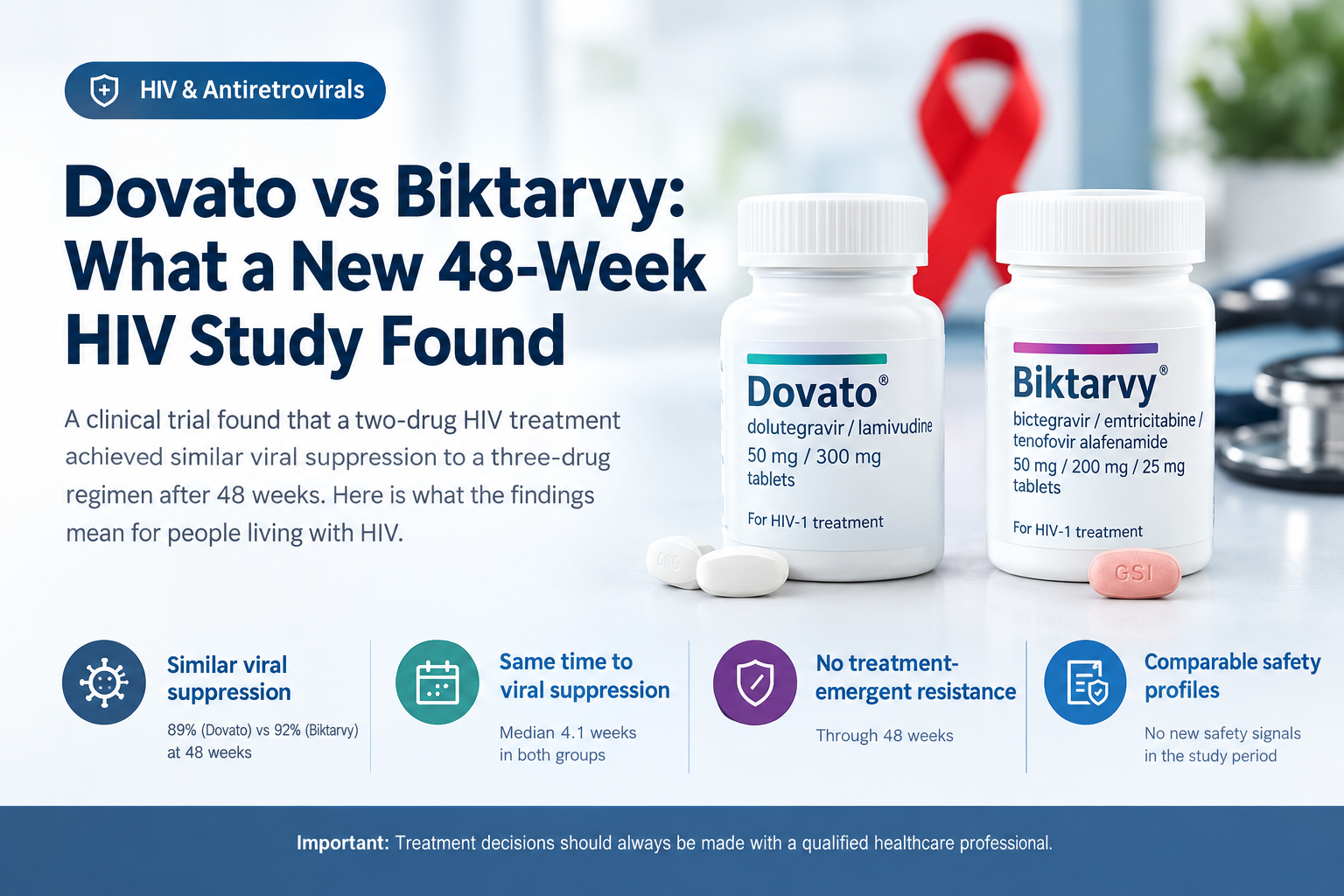
A clinical trial found that a two-drug HIV treatment achieved similar viral suppression to a three-drug regimen after 48 weeks. Here is what the findings mean for people living with HIV.
Advances in HIV treatment continue to improve the options available to people living with HIV-1. One important area of research is whether a treatment containing two antiretroviral medicines can provide effective viral suppression comparable to a regimen containing three medicines.
The VOGUE clinical trial investigated this question by comparing Dovato, a two-drug treatment, with Biktarvy, a three-drug treatment, in adults starting HIV treatment for the first time.
The study reported that Dovato was noninferior to Biktarvy for viral suppression at 48 weeks. Both treatments demonstrated substantial effectiveness, and researchers did not identify treatment-emergent drug resistance in either group during the study period.
These findings add to the evidence on simplified HIV treatment. However, choosing an appropriate regimen still requires an individual clinical assessment.
What Are Dovato and Biktarvy?
Dovato and Biktarvy are prescription antiretroviral treatments used to manage HIV-1 infection. Although both are designed to suppress the virus, they contain different combinations of medicines.
Dovato: A two-drug HIV treatment
Dovato contains two active ingredients:
- Dolutegravir: An integrase strand transfer inhibitor (INSTI) that blocks an enzyme HIV uses to integrate its genetic material into human cells.
- Lamivudine: A nucleoside reverse transcriptase inhibitor (NRTI) that interferes with an enzyme HIV needs to replicate.
Together, these medicines help control HIV replication and support sustained viral suppression when the regimen is appropriate for the individual.
Biktarvy: A three-drug HIV treatment
Biktarvy contains three active ingredients:
- Bictegravir: An integrase strand transfer inhibitor.
- Emtricitabine: A nucleoside reverse transcriptase inhibitor.
- Tenofovir alafenamide: A nucleotide reverse transcriptase inhibitor.
These medicines work together to inhibit different stages of the HIV replication process.
Both treatments are available as combination tablets. The number of active ingredients alone does not determine which treatment is best; clinical history, resistance, other health conditions, drug interactions and treatment guidelines all matter.
What Did the VOGUE Study Investigate?
VOGUE was a phase 3b, randomized, open-label, noninferiority clinical trial comparing dolutegravir/lamivudine (DTG/3TC) with bictegravir/emtricitabine/tenofovir alafenamide (BIC/FTC/TAF) as initial HIV-1 treatment.
The study included 509 adults who had not previously received HIV treatment. Participants were randomly assigned to one of the two treatment groups:
- Dovato group: 254 participants.
- Biktarvy group: 255 participants.
The trial included people with different levels of HIV viral load and immune function. At the start of the study, 47% of participants had a viral load of at least 100,000 copies/mL, while 16% had a CD4 cell count below 200 cells/mm³.
The primary outcome was the proportion of participants whose HIV-1 RNA level was below 50 copies/mL at week 48. This is a commonly used measure of viral suppression.
The results were published in Open Forum Infectious Diseases in July 2026.
Key Findings at 48 Weeks
The study found that both treatment groups achieved high rates of viral suppression.
| Study outcome | Dovato | Biktarvy |
|---|---|---|
| Participants assigned to treatment | 254 | 255 |
| Viral suppression at week 48 | 89% | 92% |
| Median time to viral suppression | 4.1 weeks | 4.1 weeks |
| Confirmed virologic withdrawals | 7 | 7 |
| Treatment-emergent resistance identified | None | None |
Source: VOGUE trial, published in Open Forum Infectious Diseases, 2026.
1. Dovato met the noninferiority endpoint
At week 48, 89% of participants in the Dovato group achieved viral suppression, compared with 92% in the Biktarvy group.
The adjusted difference was −3 percentage points, with a 95% confidence interval ranging from −8 to 2 percentage points. This met the trial’s predefined noninferiority criterion.
In simple terms, the results were consistent with Dovato providing viral suppression that was not unacceptably worse than Biktarvy under the study’s specified statistical criteria.
Noninferiority does not mean the treatments produced identical results, nor does it establish that one is better for every patient.
2. Both treatments achieved viral suppression at a similar pace
The median time to viral suppression was 4.1 weeks in both groups.
This suggests that the typical time to reach the study’s viral suppression threshold was similar between the two treatment groups. Individual responses can vary, and ongoing viral load testing remains important after treatment begins.
3. No treatment-emergent resistance was identified
Researchers reported no treatment-emergent resistance in either group through week 48.
Drug resistance occurs when changes in HIV make medicines less effective. Although the result is encouraging, it does not prove that resistance can never develop. Longer follow-up and continued monitoring are important.
4. Overall safety outcomes were comparable
The study reported comparable overall safety profiles and no new safety signals during the observation period.
This finding should not be interpreted as meaning that either medicine is free of side effects. Individual tolerability and safety depend on a person’s health, other medicines and clinical circumstances.
Why Do These Findings Matter?
The VOGUE results contribute to research into effective HIV treatment using fewer active medicines.
For suitable patients, a two-drug regimen may offer a simplified treatment option while maintaining strong viral suppression. However, fewer ingredients do not automatically mean fewer side effects, lower costs or better long-term outcomes.
The trial also adds evidence about initial treatment in a population that included participants with high viral loads and low CD4 counts. This is clinically relevant because treatment decisions must account for the person’s immune status and other factors at diagnosis.
Importantly, the study followed participants for 48 weeks. It does not, by itself, establish comparative effectiveness over many years or prove that either regimen is preferable in every clinical situation.
Is Dovato Suitable for Everyone Living With HIV?
No. Dovato is an effective treatment option for appropriately selected patients, but it is not suitable for everyone.
Before prescribing dolutegravir/lamivudine, a healthcare professional may need to consider:
- HIV drug resistance: Resistance testing and previous antiretroviral exposure can affect whether both medicines are expected to work.
- Hepatitis B infection: Lamivudine alone is not adequate treatment for HIV and hepatitis B coinfection. A regimen with medicines active against both infections may be required.
- Previous treatment history: Prior treatment failure, previous medicines and relevant resistance results may influence regimen selection.
- Other medicines: Drug interactions, including those affecting dolutegravir, must be reviewed.
- Other health considerations: Kidney and liver function, pregnancy-related considerations and other medical conditions may affect treatment decisions.
Biktarvy also has its own prescribing considerations, potential adverse effects and drug interactions. A clinician should evaluate both options against the patient’s circumstances and current treatment guidelines.
Never start, stop or switch HIV medication based solely on a news report or clinical trial headline. Interrupting effective treatment without medical guidance can lead to viral rebound and other health risks.
What Do the Results Mean for People Already Taking HIV Treatment?
The VOGUE study examined adults starting HIV treatment, so its findings should not automatically be applied to people who are already stable on another regimen.
Switching treatment involves a separate clinical assessment. A healthcare professional may review current viral suppression, previous treatment failures, resistance results, hepatitis B status, tolerability, interactions and the reason for considering a change.
People whose current treatment is working well should not assume that switching to a two-drug regimen would provide an additional benefit.
The Importance of Ongoing HIV Monitoring
Regardless of which antiretroviral regimen is prescribed, continued clinical care is essential.
Viral load testing helps assess whether treatment is controlling HIV. CD4 cell counts provide information about immune function, while other laboratory tests may be needed to monitor medicine safety and relevant health conditions.
Taking treatment consistently as prescribed and attending follow-up appointments help support long-term HIV management.
Effective antiretroviral therapy can allow people living with HIV to maintain their health and achieve sustained viral suppression. When viral suppression is maintained, HIV is not sexually transmitted; this is commonly described as Undetectable = Untransmittable (U=U).
Frequently Asked Questions
Is Dovato as effective as Biktarvy?
In the VOGUE trial, Dovato met the predefined noninferiority criterion for viral suppression at 48 weeks. Viral suppression was achieved in 89% of the Dovato group and 92% of the Biktarvy group. The findings do not mean the treatments are interchangeable for every patient.
What does noninferior mean in an HIV clinical trial?
Noninferiority means that the study results met a predefined statistical threshold showing that the treatment being evaluated was not unacceptably less effective than the comparator for the selected outcome. It does not mean the treatments are identical.
Did the VOGUE study identify HIV drug resistance?
No treatment-emergent resistance was identified in either treatment group through week 48. This is encouraging, but it does not eliminate the possibility of resistance developing in the future.
Can someone switch from Biktarvy to Dovato?
Some people may be suitable candidates for a clinician-supervised switch, but the VOGUE study evaluated initial treatment rather than switching in people already taking Biktarvy. A healthcare professional must assess individual eligibility before making a change.
Does this study mean two-drug HIV treatment is always better?
No. The study supports the effectiveness of a particular two-drug regimen in the population studied. The best regimen depends on treatment history, resistance, hepatitis B status, other health conditions, potential interactions and individual needs.
Conclusion
The VOGUE trial provides encouraging evidence that Dovato can achieve viral suppression comparable to Biktarvy at 48 weeks when used as initial HIV-1 treatment in appropriately evaluated adults.
The study found similar median times to viral suppression, comparable overall safety outcomes and no treatment-emergent resistance in either group during the observation period.
These findings support continued research into simplified HIV treatment, but they do not establish that one regimen is universally better or suitable for everyone. Treatment decisions should be individualized and made with a qualified healthcare professional.
Medical disclaimer: This article is for educational purposes only and does not replace professional medical advice, diagnosis or treatment. Consult a qualified healthcare professional for advice about HIV treatment and before making any medication changes.
References
- Ghosn J, et al. VOGUE: Noninferior Efficacy of Dolutegravir/Lamivudine Versus Bictegravir/Emtricitabine/Tenofovir Alafenamide in Adults With HIV-1 Naive to Treatment. Open Forum Infectious Diseases. 2026;13(8). Read the peer-reviewed study.
- National Institutes of Health. Guidelines for the Use of Antiretroviral Agents in Adults and Adolescents With HIV. Initial combination antiretroviral regimens.